China Best Garage Door With Door for Global Buyers?
Choosing the China best garage door with door requires more than comparing catalog prices. Global buyers need evidence about safety, insulation, durability, and after-sales support. The phrase garage door with door often describes a sectional or rolling garage door with an integrated pedestrian door. That small opening can improve daily access. It can also create sealing, alignment, and safety challenges.
Market data shows steady demand, but published estimates vary widely. Fortune Business Insights valued the global garage door market at about USD 2.3 billion in 2024 and projects continued growth through 2032. Grand View Research reports a larger market estimate because it includes broader product categories and regional segments. This difference matters. Buyers should check each report’s scope before trusting a headline number.
Real purchasing experience reveals practical details that statistics can miss. A showroom sample may close quietly, yet a poorly packed shipment can arrive with scratched panels or bent tracks. Reliable Chinese manufacturers should provide load testing, wind-resistance data, installation drawings, and documented quality inspections. Products may also need to align with requirements such as EN 13241, CE-related obligations, UL 325, or local building codes, depending on the destination.
Not every low-cost option is a smart purchase. A cheaper door can increase maintenance costs. Insulation values, hardware grade, cycle testing, seal performance, and spare-part availability deserve equal attention. Buyers should request samples, factory videos, test certificates, and clear warranty terms. This guide examines leading Chinese options through those practical standards, while acknowledging one uncomfortable truth: product claims still require independent verification.
What Defines a China Garage Door with Pedestrian Door for Global Buyers?
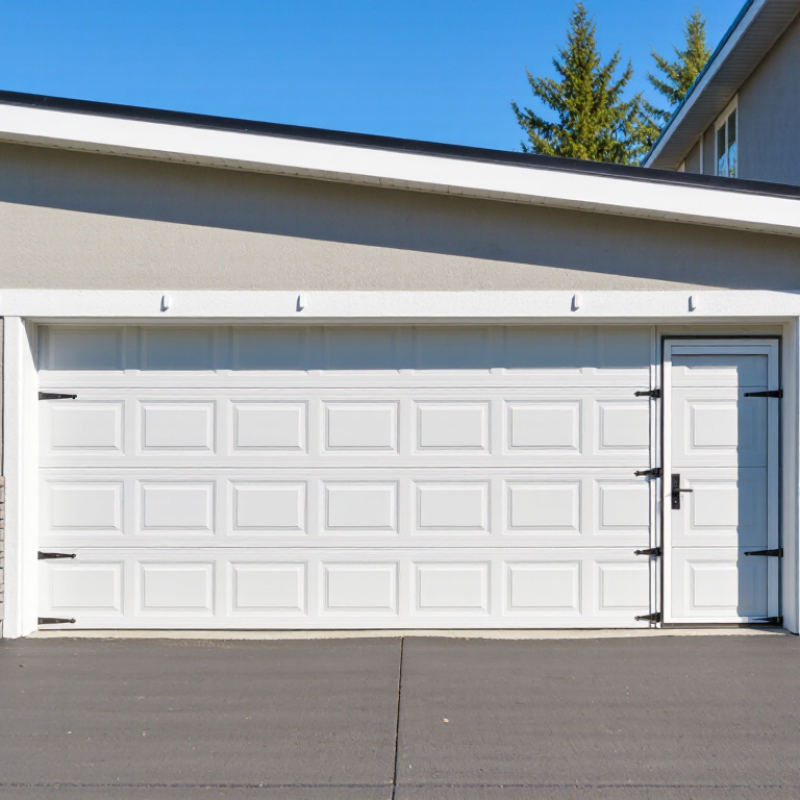
For global buyers, a China garage door with a pedestrian door must serve two purposes without weakening either one. The main door should open smoothly for vehicles, while the smaller door should provide convenient daily access. A practical design includes a reinforced frame, durable hinges, weather seals, and a reliable lock. Door size, insulation, wind resistance, and surface finish should match the project location.
Real project experience shows that small details often affect long-term performance. A low threshold can improve accessibility, but it may allow water to enter during heavy rain. A thicker panel can improve insulation, yet it may require stronger springs or an upgraded opener. Buyers should request drawings, material details, load information, and sample photos before production. Factory quality checks should cover panel alignment, pedestrian-door clearance, hardware operation, and protective packaging.
Installation conditions also matter. Uneven floors, limited headroom, or unstable walls can create problems after delivery. The supplier should provide clear installation instructions and confirm the opening dimensions in writing. Regional electrical requirements must also be checked before selecting an automatic system. Some specifications may still need adjustment after a site inspection. That is not a failure; it is part of responsible planning. A dependable supplier communicates limitations honestly, records agreed changes, and supports replacement parts when practical.
China Best Garage Door With Pedestrian Door for Global Buyers
Common residential garage-door opening widths used in international projects are shown below. These reference dimensions help global buyers evaluate whether a garage door with an integrated pedestrian door can fit different vehicle-access requirements.
The 2,400–2,500 mm range is commonly used for single-car garages, while wider openings from 3,000–4,000 mm are typically selected for larger vehicles or two-car access. Final dimensions should be confirmed against the building opening, vehicle size, local safety requirements, and the clear pedestrian-door passage.
Steel, Aluminum, and Insulation: Comparing U-Values and Durability
China Best Garage Door With Door for Global Buyers?
Steel, aluminum, and insulation behave differently in real garage conditions. Steel offers strong impact resistance and stable panel geometry. Aluminum resists corrosion well, especially in humid coastal regions, but dents more easily. ASHRAE Handbook—Fundamentals lists approximate thermal conductivities near 50 W/m·K for steel and 205 W/m·K for aluminum. Both metals conduct heat quickly without a thermal break.
Insulation changes the result dramatically. Polyurethane foam typically has a conductivity near 0.02–0.03 W/m·K, according to ASHRAE material data. Lower U-values indicate better heat-flow resistance. The U.S. Department of Energy explains that U-factor measures total assembly heat transfer, not only the panel core. DASMA Technical Data Sheet 163 also warns that garage-door R-values can vary by testing method. A door advertised at R-18 may not deliver the same whole-door performance. That detail is often missed.
Tips: Ask for the complete-door U-value, test standard, panel thickness, and air-infiltration data. Check the bottom seal, side seals, and thermal breaks. A well-insulated panel can still leak around a poorly fitted frame. For cold climates, steel with polyurethane usually gives a practical balance of strength and insulation. In salty environments, aluminum may last longer, though its lower stiffness needs careful reinforcement. These choices are not perfect. Door size, installation quality, and local weather can outweigh brochure numbers.
How ASCE 7 Wind Loads Determine Garage Door Performance by Region
China Best Garage Door With Door for Global Buyers?
ASCE 7 wind loads help determine how a garage door should perform in different regions. The required resistance depends on basic wind speed, building height, terrain, and exposure category. Coastal sites usually face stronger pressure than sheltered inland locations. Large openings also demand careful design. A garage door must resist both inward and outward forces during severe storms. It is not only about the door panel.
For global buyers, regional data should guide every specification. Ask for tested design pressures, structural calculations, and installation requirements. A qualified engineer should verify the door against local building codes. Frame anchorage matters too. Weak fasteners can fail before the panel does. Many buyers focus on appearance first. That assumption is risky. I have seen small installation details create large performance problems.
Tips:
Confirm the project’s ASCE 7 edition, wind speed, exposure category, and opening size. Check whether the door includes impact protection where local rules require it. Request clear test reports, maintenance guidance, and replacement-part information. Do not compare products using wind speed alone; pressure ratings offer a more useful comparison. Recheck the design when the building changes, because a new roof, canopy, or nearby structure can alter wind behavior.
Factory Audits, CE Marks, and ASTM Tests for Verifiable Product Quality
For global buyers, a garage door should be judged by evidence, not polished photographs.
A factory audit can verify welding areas, panel storage, traceability, and final inspection records. During a practical audit, check whether batch numbers follow the door from raw steel to packaging. One missing record can weaken an otherwise impressive report.
CE marking requires documented conformity with applicable European requirements.
It is not a universal quality certificate. For powered doors, buyers should review the Declaration of Conformity, risk assessment, installation instructions, and relevant harmonized standards, including EN 13241 and EN 12453 where applicable. Test reports should identify the exact model, motor, safety edge, and control system. Generic reports create doubt. The European Commission’s 2023 Safety Gate report recorded 3,412 product alerts, showing why traceable compliance remains important.
ASTM evidence adds value when the destination market requests it.
ASTM F2200 addresses automated vehicular gate construction, but it should not be treated as a complete garage-door approval by itself. Ask for laboratory scope, sample photographs, test dates, and failure observations. A serious supplier can explain why a door passed, not merely display a certificate. ISO’s 2023 survey recorded more than one million ISO 9001 certificates worldwide, yet certification alone cannot prove every shipment matches the audited process. That is the uncomfortable part. Buyers still need pre-shipment inspections, impact checks, cycle testing, and random measurement of panel thickness. Mistakes happen. Good documentation makes them visible.